
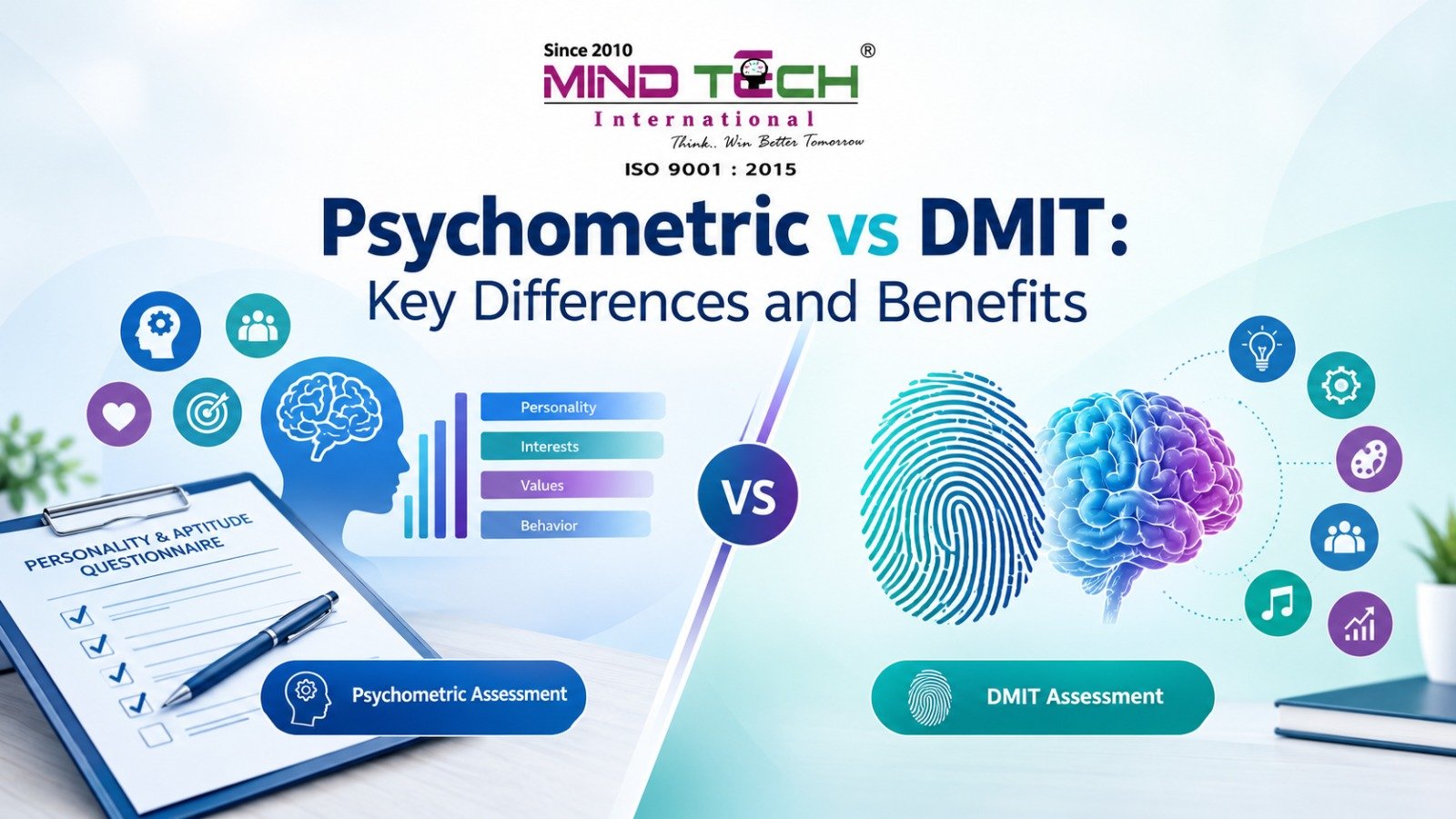

Understanding your strengths, interests, learning preferences, personality, and career direction can help you make more informed decisions about education and professional growth. Two assessment approaches often discussed in this context are psychometric assessments and DMIT (Dermatoglyphics Multiple Intelligence Test).
Although both can provide insights about an individual, they differ in their approach, the type of information they aim to highlight, and how the results may be used in counselling. Understanding these differences can help students, parents, and professionals decide which approach better suits their requirements.
Psychometric vs DMIT: What Is the Difference?
Psychometric assessments generally use structured tests and questionnaires to evaluate areas such as personality, aptitude, interests, behavioural tendencies, or other psychological characteristics. The results are interpreted using established assessment frameworks and can be useful in education, recruitment, counselling, and career planning.
DMIT, on the other hand, is presented as an assessment approach that uses dermatoglyphic patterns along with multiple-intelligence and related analysis to generate insights into natural strengths, learning preferences, abilities, and potential areas of development.
While psychometric assessments typically depend on responses provided during the assessment, DMIT focuses on information derived from fingerprint patterns and combines this with structured analysis and counselling to create an individual profile.
Key Differences Between Psychometric and DMIT
| Aspect | Psychometric Assessment | DMIT |
| Primary approach | Structured tests, questionnaires and assessments | Dermatoglyphic patterns with structured analysis |
| Areas explored | Personality, aptitude, interests, behavioural traits and other psychological factors | Multiple intelligences, learning preferences, natural strengths and related traits |
| Information source | Responses and performance during assessment | Fingerprint patterns and assessment-based analysis |
| Common application | Career guidance, recruitment, education and psychological assessment | Self-awareness, learning guidance, career exploration and counselling |
| Counselling role | Can be combined with professional interpretation | Counselling can be used to explain the profile and its implications |
| Focus | Understanding measured psychological or behavioural characteristics | Exploring potential strengths, learning preferences and individual characteristics |
How Can DMIT Help With Self-Awareness?
DMIT can be used as one input within a broader counselling process. Rather than looking at a student only through academic performance, the assessment approach can provide additional perspectives on areas such as learning preferences, multiple intelligences, behavioural patterns, and natural strengths.
For parents, these insights may help create more meaningful conversations around a child’s learning and development. For students, they can provide another perspective when exploring subjects, skills, and possible career directions.
Professionals may also use assessment insights as part of broader self-reflection and personal development.
Why Choose DMIT?
There are several reasons individuals may consider DMIT as part of their assessment and counselling journey.
1. Explore Natural Strengths
DMIT can provide insights into areas where an individual may demonstrate particular strengths or preferences. This can encourage people to look beyond marks or conventional academic indicators when understanding their abilities.
2. Understand Learning Preferences
Students do not always learn in exactly the same way. Understanding individual learning preferences can help students, parents, and educators think about more suitable approaches to learning and development.
3. Support Career Exploration
Career decisions can be challenging, particularly when students have multiple interests. DMIT insights can be considered alongside academic performance, interests, aptitude, personality, and professional counselling when exploring potential career directions.
4. Encourage Self-Awareness
A better understanding of personal characteristics can help individuals reflect on their strengths, areas for improvement, preferences, and goals.
5. Combine Assessment With Counselling
An assessment report becomes more meaningful when its findings are discussed with a qualified counsellor. Counselling can help translate assessment insights into practical conversations about education, skills, career choices, and personal development.
DMIT Should Be Considered as Part of a Broader Assessment Process
Choosing DMIT does not mean ignoring other relevant information. A person’s career direction should not ideally be determined by one assessment alone.
Academic performance, interests, aptitude, personality, skills, goals, family considerations, and real-world opportunities can all contribute to better decision-making.
DMIT can serve as one additional input in this process, helping individuals explore areas that may otherwise receive less attention.
MindTech International and DMIT-Based Guidance
MindTech International focuses on helping students, parents, and professionals understand individual potential through assessment and counselling-based approaches.
Its services include DMIT and Mid Brain Activation, with an emphasis on exploring areas such as natural strengths, learning styles, personality characteristics, behavioural patterns, multiple intelligences, abilities, and possible career directions.
The organisation combines assessment reporting with expert counselling so that individuals can better understand their results rather than simply receiving a report without context.
According to its approach, DMIT is positioned as a well-researched and reliable assessment approach that brings together technology, psychological perspectives, and data-driven analysis to generate individual insights.
Is DMIT Better Than Psychometric Testing?
There is no universal answer that one assessment is better for everyone. Psychometric assessments and DMIT have different approaches and may serve different purposes.
DMIT may be particularly appealing to people who want to explore natural strengths, learning preferences, multiple intelligences, and individual characteristics through a different assessment framework.
For the most useful outcome, the assessment should be followed by meaningful counselling and considered alongside other relevant information rather than being treated as the sole basis for an important education or career decision.
Frequently Asked Questions
1. What is the main difference between psychometric assessment and DMIT?
Psychometric assessments generally use structured tests or questionnaires to evaluate psychological, behavioural, aptitude, or interest-related characteristics. DMIT uses dermatoglyphic patterns and structured analysis to explore areas such as multiple intelligences, learning preferences, and natural strengths.
2. Why should I choose DMIT?
DMIT may be useful if you want additional insights into learning preferences, natural strengths, multiple intelligences, and potential areas for development as part of a broader counselling process.
3. Can DMIT help with career decisions?
DMIT can contribute to career exploration by providing additional insights into an individual’s characteristics and preferences. However, career decisions should also consider interests, aptitude, academic performance, skills, goals, and professional counselling.
4. Is DMIT useful for students?
DMIT can be used as a self-awareness and counselling input for students who want to explore their learning preferences, strengths, abilities, and possible career directions.
5. Is psychometric testing the same as DMIT?
No. They use different assessment approaches and are designed around different frameworks for gathering and interpreting individual information.
6. Does MindTech International provide DMIT-based guidance?
Yes. MindTech International uses DMIT as part of its assessment and counselling-oriented approach for students, parents, and professionals seeking greater self-awareness and career clarity.
Conclusion
Psychometric assessments and DMIT offer different approaches to understanding individual characteristics. While psychometric testing can examine areas such as personality, aptitude, interests, and behavioural characteristics through structured assessments, DMIT provides another framework for exploring natural strengths, learning preferences, multiple intelligences, and related individual traits.
For those seeking a broader perspective on self-awareness and career exploration, DMIT can be considered alongside counselling and other relevant personal and academic information. MindTech International aims to use this approach to help individuals better understand themselves and make more informed decisions about education, career, and personal growth.